Le renouveau du tramway

Le tramway, ou « tram » moderne est un transport en commun urbain ou interurbain tracté électriquement sur des rails plats, installés ou non en site propre ou sur la voie routière à l’aide de rails à gorge.

Le tramway de Paris

Le tramway de Paris

Longtemps resté le mode de transport urbain privilégié des villes grandes et moyennes, voire de leurs banlieues immédiates, le tramway, moins couteux à installer qu’un métro, pouvant transporter plus de passagers qu’un bus, a régné en maitre de la fin du XIXème siècle jusqu’à l’évènement de la voiture-pour-tous.  Toutefois, la congestion des centres-villes, traduite par d’importants embouteillages ainsi que la pollution en résultant, ont vite présenté les limites du mythe de l’automobile personnelle. Il faudra attendre le choc pétrolier de 1973 pour que la réflexion sur l’aménagement des villes conduise à repenser le tramway comme une alternative crédible, moins dispendieuse et plus agréable.

Le tramway de Montpellier

Le tramway de Montpellier

Cette idée commence à se concrétiser à la faveur des années 1980, lorsque les villes de Nantes et Grenoble s’équipent du nouveau tramway français standard (TFS) d’Alstom, à peine imaginé en 1975. Ces deux projets démontrent  l’utilité du tramway en tant que vecteur d’une nouvelle politique de la ville. Désormais, celle-ci est repensée au service des citadins. Moins bruyant, plus vert, plus clair, le tram reconfigure les quartiers, s’affranchit du vacarme et de la pollution. Des réformes politiques, l’impôt versement transport dans les années 1970, puis la décentralisation progressive, conférant, dans les années 1980, aux collectivités locales, la gestion de l’organisation des transports publics, permettent le renouveau urbain de grandes villes françaises. Peu à peu, Bordeaux, Nancy, Rouen, Strasbourg, Toulon, Saint-Etienne, Orléans, Le Mans Montpelier, Mulhouse, Nice ou Toulouse emboitent le pas et les centres-villes se piétonnisent, le patrimoine historique est mis en valeur. Dans les années 1990-2000, les plans de développement urbain (PDU) incitent à diminuer la circulation automobile dans les villes (loi LAURE de 1996), et deviennent même obligatoires pour les agglomérations de plus de 100 000 habitants.

Le tramway Rhonexpress de Lyon

Le tramway Rhonexpress de Lyon

Or, seuls les plus densément peuplées peuvent se permettre de construire un métro (Lille, Marseille, Lyon, Toulouse, Rennes), et le bus n’est pas toujours suffisant et présente une partie des inconvénients de la voiture (bruit, pollution, encombrement). Le tramway tend donc depuis lors à s’imposer, et ce, d’autant plus qu’en 2000, la loi sur la Solidarité et le Renouvellement Urbain (SRU) amène les schémas de cohérence territorial (SCOT) à repenser nombre de villes française sur le long terme.

Le tramway de Bordeaux

Le tramway de Bordeaux

En 2003, Bordeaux ouvre donc trois nouvelles lignes, en 2006, Mulhouse et Valenciennes mettent en service leurs premières lignes tandis que Clermont-Ferrand inaugure un tramway sur pneu et que Paris continue à mailler ses couronnes.

En 2010, dix-neuf agglomérations françaises avaient fait ce choix, pour près de 407 km de lignes.  Le tramway français présente une vitesse commerciale moyenne de 18 km/h à 22 km/h et peut desservir plus de 3000 voyageurs par heure et par sens, pour un coût d’installation représentant 1/3 de celui d’un métro, soit de 13 à 22 millions d’euros par kilomètre.

Toronto Streecar

Toronto Streecar

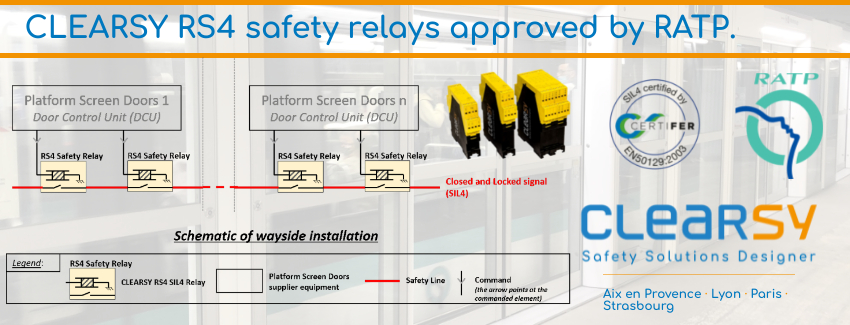
Il offre en outre un confort élevé, est régulier et accessible, y compris pour les personnes à mobilité réduite. De plus, le tram permet le partage de voirie avec les piétons, vélos et autres trottinettes grâce à des systèmes de signalisation sécuritaires bien conçus, notamment le système sécuritaire KFS SIL2 conçu par Clearsy et actuellement exploité sur le tramway Rhônexpress et bientôt à Valenciennes, ainsi que les compteurs d’essieux sécuritaires SIL4 pouvant remplacer les circuits de voies et les relais sécuritaire SIL4 RS4 et relais de signalisation.

Cet essor du tramway, ces trente dernières années, n’est toutefois pas un phénomène propre à la France. S’il est vrai que comme pour celle-ci, les réseaux de tram occidentaux furent démantelés peu après la seconde  guerre mondiale, voire parfois jusque dans les années 1960, l’idée refait son chemin en Europe, d’une part car les villes sont bâties sur autour des centres-villes historiques comme en France, et d’autre part car les pays du bloc soviétique n’ont jamais abandonné le tram, et présentaient donc un modèle de mobilité urbaine, qui, une fois la guerre froide terminée, pouvait enfin se confronter au tout-automobile occidental. A titre d’exemple, le tramway de Saint Petersburg voit passer 476 millions de passagers par an.

Le tramway de Toronto

Le tramway de Toronto

Néanmoins, la France, a bel et bien initié un renouveau du tramway, jusque par-delà l’Europe, comme en témoigne,pour 2012, une série d’appels d’offre auBrésil (Santos, Cuiabà et Goiânia). Le tram séduit désormais par samodernité, son intégration urbaine et son efficacité écologique.

Les années 1990 voient la ré-émergence du tramway dans les grandes villes des Etats-Unis tandis que l’Espagne (une dizaine de villes dont Barcelone et Grenade),

Le tramway d' Hong Kong

Le tramway d’ Hong Kong

États-Unis tandis que l’Espagne (une dizaine de villes dont Barcelone et Grenade), l’Algérie (Alger, Oran, Constantine, Sétif), la Tunisie (Tunis), le Maroc (Rabat, Casablanca, Tanger, Agadir, Fès, Marrakech), repensent leurs villes avec tramway en ce moment même.

Certaines grandes mégapoles de Chine telles Beijing ou Nanjing ont-elles aussi cette ambition contagieuse. Aussi il est à prévoir une forte activité de construction de lignes de tramway pour les vingt prochaines années, non plus en France, mais dans les villes, d’Inde, de Chine et d’Amérique Latine.

Le tramway de Barcelone

Le tramway de Barcelone

Cette préexistence du marché français a par ailleurs permis la constitution d’entreprises d’ingénierie disposant d’un savoir-faire éprouvé et reconnu internationalement  en matière de tramway (Artelia, Ingerop, Egis, Systra, Clearsy), de matériel roulant (Alstom Transport, Lohr) ou de travaux publics (Bouygues, Eiffage, Vinci), bien positionnées pour récupérer un marché qui s’annonce prometteur.


SIFER 2013 in Lille from 26th to 28th march

ClearSy will participate to the SIFER 2013 Railway Fair, which will hold in Lille, Grand Palais, from 26th to 28th Mars 2013. On its stand, ClearSy presented it’s railway expertise in the development of secure systems.

SIFER 2013


Innotrans 2012 from september 18th to 23rd in Berlin

ClearSy attended the Innotrans show, which is the reference exhibition in the railway domain and took place in Berlin from 18st to 23th September 2012. The show enables the greatest protagonists from the railway world to come together around safe, innovative solutions.

image013

ClearSy had a stand at the show, where it presented its expertise as well as its systems and references in the domain of creating railway safety systems.


UITP 2013 railway fair in Geneva

ClearSy will attend the UITP 2013 Railway Fair, which will take place in Geneva from 27th to 29th May 2013.

UITP 2013


Negocios nos trilhos 2012 in Sao Paulo

Negocios nos trilhos 2012

Clearsy Introduced during this fair the FERSIL railway products and particularly the security systems and software (SIL1 to SIL4):

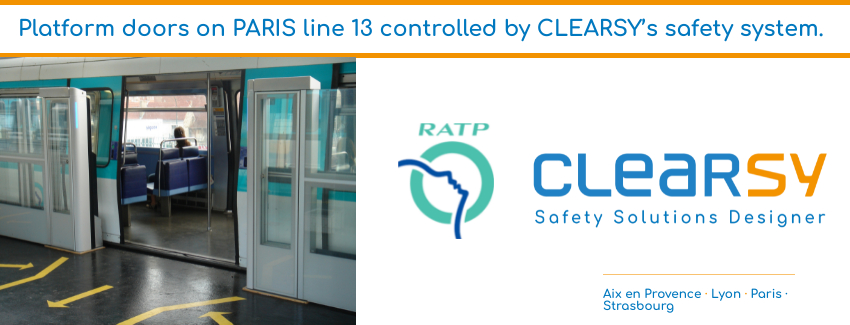
  • Open and close the Platform screen doors,
  • Automatic Train Stop,
  • System control of train overspeed,
  • Track safety monitoring,
  • Platform detection,
  • Axle counters,
  • Safety relays,
  • etc.

Catalogue France
Activities & Products figured in the french catalog :

  • COPPILOT SYSTEM: Device to open and close the Platform screen doors. Safety critical SIL3 system, currently on the line 1 & 2 of the São Paulo subway.
  • KFS SYSTEM: SIL2 Automatic Train Stop (ATS), installed in France trains and tramway
  • KPVA SYSTEM : System control of train overspeed, installed in Paris, trains and subway
  • DIL SYSTEM : Track safety monitoring
  • GAPS SYSTEM: Platform detection, STI PMR Standard, opening and closing gap filler authorization
  • Axle counters
  • Safety relays

References

COPPILOT System installed in the subways stations of SãoPaulo, Subway of Paris, Subway of Santiago, Subway of New York

Photos:


A new revolution in Paris

The line 1 of the Parisian subway is becoming automatic although no one notices it.

With 725 000 passengers daily and 111 years of existence, the most famous metro line of Paris, the first one ever set up in France, the Line 1, had to renew itself. It has been done this November 3rd; the first new MP05 rakes were inaugurated. They present a multitude of advantages: driverless, air-cooling and a low-noise system, and a better capacity (734 passengers standing up or 216 seating).

However, the main asset of this automation is the reduction of turn-over time between two trains from 105 secs to 85 secs.

But the great prodigy stands behind: Between 2007, year of the beginning of the process with the installation of PSDs along the metro stations, and 2011 the inauguration of the new rakes, there has not been a single interruption of traffic or any delays. Moreover, currently, both automatic and manual trains roll on the same rails (first time ever!). Furthermore, an agreement has been reached between the drivers and the RATP board to progressively elevate the drivers to new jobs such as “exploitation supervisor” or to redirect them to other lines.

In a nutshell, the project is a total success. No doubts, the companies involved in the process will benefit from their work as a showcase of their respective abilities: Siemens for the automation, Alstom for the rolling stock, Kaba Gilgen for the Platform Screen Doors (PSD) and last but not less, Clearsy for its efficient and safe (SIL4) Platform Screen Doors Control System (PSDCS) – DOF1.


The modernization of the oldest Parisian Metro line.

Les Sablons Station - © clicsouris - Licence CC

Les Sablons Station – © clicsouris – Licence CC

One of the oldest metro of the world, the mythic Parisian first line is now equipped with Platform Screen Doors (PSD). Created in 1900, the most famous metro of Paris lives a true revolution. Indeed, the present-day line includes both automatic trains (52) and PSDs in 26 stations. The main line of Paris has became safer, strike-proof and the very quality of the transport has been upgraded by the change of the rolling stock. However, this is only the ostentatious part of this renewal. The most interesting part for us is the hidden side of the routine of the passing trains at a station… the opening and closing of Platform Screen Doors. As an iceberg which moves the way it does, only because of its invisible part, the PSDs are controlled by a discreet and far more predictable and safer system…

The keystone of critical safety

This Platform Screen Doors Control/Command System (PSDCS) is SIL3. It means that the probability of the doors opening without a train, or with a bad placed one, is inferior to 10-7 (0.000001) per hour. According to the IEC 61508, it is the second safest accreditation in railway-systems behind SIL4 which is not relevant here. The efficiency of the system is based on a simple process. A train enters a station; doing this, it rolls over a kind of narrow black carpet (on the way, at the middle of the station, between the rails). There is also an on-board transmitter in the middle of the train. If the train stops at the right place, the transmitter will be above the carpet and will form a magnetic loop between the train and the ground (the platform). This magnetic-loop enables the communications between the train and the platform and thus, the orders of opening/closing the PSDs to be transmitted from the train to the platform. This is a fail-safe system.

This PSD Control System called DOF1 (like a dolphin in French) is nothing but the paragon of a technology, the Formal B Method – a language which enables its users to translate specifications into a formal dialect(one word, one meaning) which is automatically analyzed to determine if contradictions exist between those specs. This method can be used to design bug-less software or very safe systems.

Clearsy, the know-how to combine availability and dependability.

Clearsy, the company which succeeded in designing the PSDC system is a French corporation specialized in safety critical engineering and the world leader in the use of the Formal B Method. Its Fersil department dedicated to rail-ways includes two other PSDC systems, visible in Paris 13th line and Sao Polo 2nd and 3rd line. Clearsy also created various safety systems from axels-counter to gap-fillers.


Development of SIL4 Safety Software for the Fixed Automatisms of Val de Roissy

Technical sheet

Realization of the Safety Software with the B Method

Val de Roissy

Val de Roissy

Siemens Transportation Systems (STS) has subcontracted with ClearSy for the realization with B of the safety software for the automatisms of the future VAL de ROISSY: alarm control unit (UCA) and automatic section drivers (PADS) for Siemens.

This software represents approximately 150,000 ADA lines once completed.The software is classified as SIL4, according to standards IEC61508: EN50126, EN50128, EN50129.


The Simplified System

Schéma du Val de Roissy

Val de Roissy – Schema

A few figures…

On the L1 VAL line inaugurated on 4 April 2007, 2 computers have been installed: the UCA and PADS (as many PADS as required – S for Section).

For the PADS software:

  • 186,440 lines for the AS Ada safety code (AS – Safety Application)
  • 30,632 lines for the AS non safety-critical Ada code
  • number of mathematical Proofs: 62,056
  • number of B lines: 256,653 lines

For the UCA software:

  • 50,085 lines for the AS Ada safety code
  • 11,662 lines for the AS non safety-critical Ada code
  • number of mathematical Proofs: 12,811
  • number of B lines: 65,722 lines

The number of effective B lines is smaller than that announced as comments are taken into account, including remarks which guide refinement.

A second line for Charles de Gaulles airport is due to be inaugurated in June 2007.

Publications and Feedback

  • Introduction document: realization of SIL4 safety software for the Val de Roissy: download
  • Conférence ZB2005 : Article “Using B as a High Level Programming Language in an Industrial” : téléchargez
  • Conférence ZB2005: “Using B as a High Level Programming Language in an Industrial Project” (slides): download
  • Météor : a Successful Application of B in a Large Project”, FM’99, Toulouse, France, 1999 – Behm P., Benoît P., Faivre A., Meynadier J.-M. SpringerLink.com
  • Vital software: Formal method and coded processor – ERTS 2006 – 25-27 January 2006 – Toulouse -
  • Formal Methods in Industry: Achievements, Problems, Future – Jean Raymond Abrial Swiss Federal Institute of Technology Zurich : Portal.acm.org
  • MetroPole : an article on the Val de Roissy

ClearSy presents its new railway product : the DRF-MP

DRF-MP

DRF-MP

ClearSy is pleased to announce the release of a new product in its range of railway products: the DRF-MP, a wheel sensor specially developped for the detection of tire-mounted metro.

By its form and its sensitivity different from the standard DRF, this system can be adapted to any type of tire-mounted metro, but also trams, whithout having to cut the groove of the rail.

For now, this system is being tested on line 1 of Paris Metro…


Rhônexpress: Test of Automatic Train Stop KFS (DAAT SIL2)

Rhônexpress

Rhônexpress

The KFS SIL2 system, a SIL2 certified automatic train stop mechanism (DAAT), distributed by Fersil, underwent testing at night, from September 27th to October 1st 2010, on Lyon’s Rhonexpress tramway. It’s a tramway which has the characteristic of reaching a speed of 100km/hour to link Lyon’s City-Centre and Saint Exupéry Airport in less than 30 minutes.

Due to this high speed, the group responsible for the creation of the line has decided to install a DAAT. As such it has selected the KFS SIL2 developed by ClearSy, which is in charge of automatically stopping any train that passes a shut signal. These tests were carried out by Vossloh-Cogifer, the company in charge of the signalling in this matter, on the section between the Depot/St Exupéry airport, at a speed of 10km/hr, then 100km/hr. This tests allowed to check the following:

  • the operational aspect of the SIL2 level DAAT equipment (onboard KFS sensor, Beacon on the KFSI track, and onboard KFS Processing Framework)
  • the compatibility and the interaction of the material used (given the replacement of the DAAT SILO equipment with the DAAT SIL2 equipment)
  • the start trigger of the emergency braking  where passing the signal
  • the lack of wrong emergency braking
  • the communication between the various pieces of equipment: sensors, beacons and frameworks, via control of the wiring
  • the temporary inhibition function
  • the permanent inhibition function
  • the operation of the Gong

The tests were run over 5 nights and proved conclusive: the DAAT reacted positively to all the scheduled tests, thus confirming the smooth running of the system developed by ClearSy and certified by Certifer.

The start up of the SIL2 system is scheduled for April 2011, with a gradual replacement of the current system (SIL0) with the SIL2 system.